What the Skin Remembers
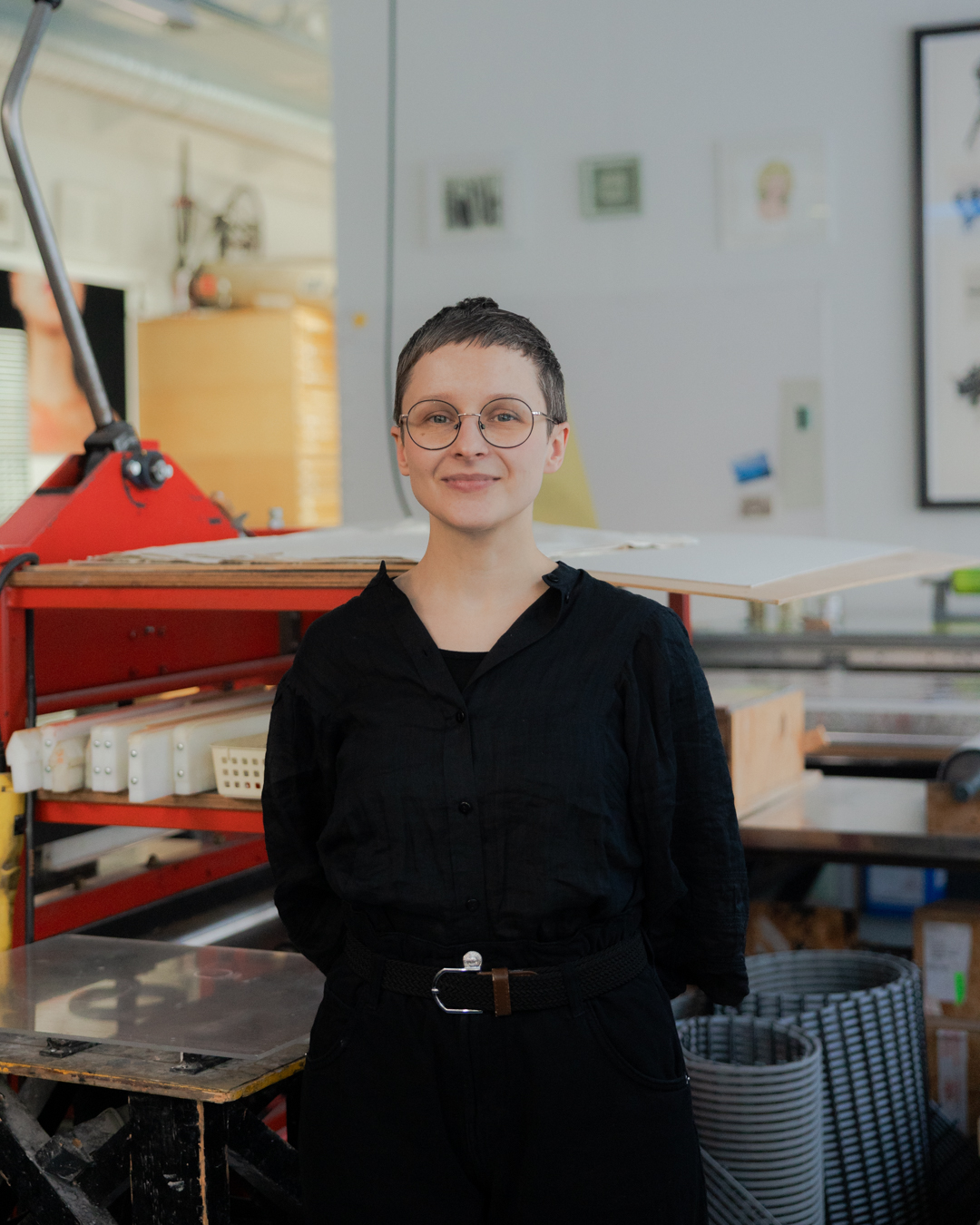
Moving between traditional printmaking methods and other media, Roma Auskalnyte explores how meaning can be pressed onto both paper and the human body — and what remains once imprints begin to fade. In 2026, she is spending three months in Rovaniemi through the Wihuri Foundation and the University of Lapland’s joint Residency Programme.
Words: Heini Huhtinen
Photos: Elias Ervast
Video: Aapo Nissi
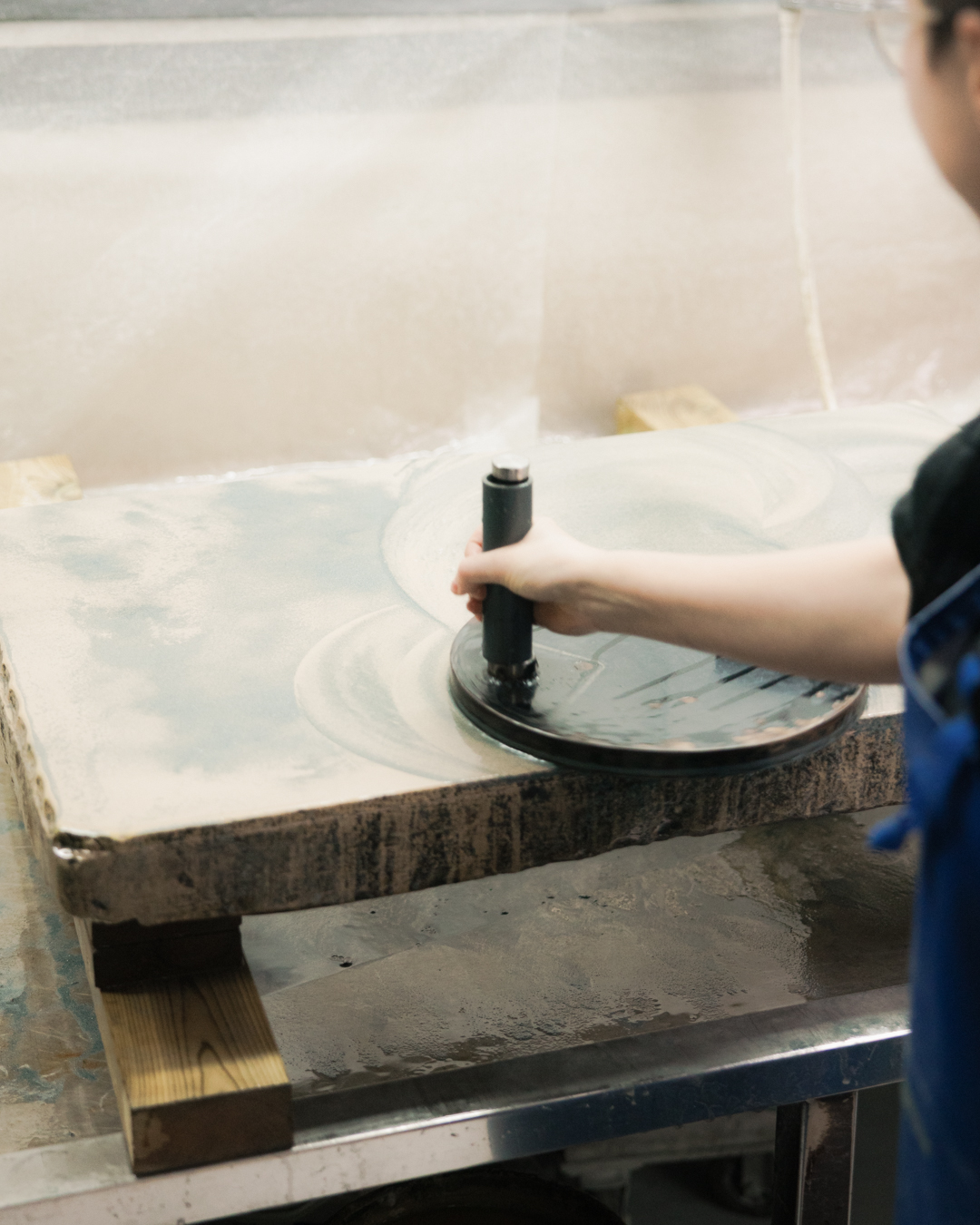
Traditional printmaking is a laborious process. Particularly lithography, which involves copying patterns onto stone or metal surfaces, can take its toll on the body.
“You have to repeat the same movements over and over again, you’re physically tired and get blisters on your fingers. There is this strong body connection in the process, but when you look at a final product – a nicely printed picture – you never see it,” says visual artist Roma Auskalnyte.
Auskalnyte initially studied traditional printmaking techniques at the Vilnius Academy of Arts, but soon started to ache for a closer connection to the prints she was working on. She was curious about what it might look like to remove the mediator between what she was drawing and the final product.
This was the initial step toward expanding into working with different media, Auskalnyte says. Many of her early works revolved around letters and text – partly because that was what seemed feasible for a newly graduated artist without access to a studio space or many other resources.
Gradually, she also started to experiment with performance, video, and photography. The common thread in Auskalnyte’s artistic practice, however, is still focused on blending traditional printmaking methods with other forms of contemporary art.
“In a way, being forced to think of other means to generate my ideas helped me reflect on what creating art really meant for me. When you are trained in a certain way, it takes time to free oneself to work in different ways.”
Body as a printing plate
The term Auskalnyte uses to describe her desire to bring the body closer to the print is fleshiness. It utilises the human body and its physicality as a tool for artistic expression, not in a gory but perhaps slightly unsettling way.
For Auskalnyte, fleshiness can mean using her body’s surface as a printing plate, or treating paper like skin – exploring how it can be torn or how exhibiting damages its surface, for example.
A piece called Tears shows bronze-cast hands holding the words love and care. The same words can also be seen imprinted on Auskalnyte’s cheeks, evoking the resemblance of tears and implying that the love and care offered might not always be what is expected or hoped for.
In her first ever video performance, entitled Punishment, the artist can be seen kneeling on a printing plate, the letters on the plate pressing a text onto her knees saying In text I trust / In written truth / I believe / Read more. In connection to the piece, Auskalnyte writes about a punishment used in Lithuanian schools, where a misbehaving pupil is sent to kneel in a corner on dry peas. She also states that she has always been suspicious of written texts, yet has had to live by them anyway.
”I think we have been taught to believe that what is written is the unquestionable truth. But there is always this gap between the text and the reality they claim to represent.”
A sense of instability or impermanence is also typically strongly present in Auskalnyte’s work. Imprints on skin fade away, as do those on paper, eventually.
Who claims the victory?
When Auskalnyte has a new idea, figuring out the right medium to communicate it to viewers typically involves a lot of experimentation, reading, looking at art, frustration, and then perhaps completely new paths.
“I guess creativity is a very personal process for each artist, and it’s tricky figuring out the right recipe for generating ideas. But for me, I often just need time.”
Sometimes a memory or observation that has been sitting on the periphery of her mind for years can make its way back into focus and turn into an impetus for new work. This happened with a lithographic piece Auskalnyte created in 2021, entitled Trophy.
The work is made up of black lithography prints, which represent a kind of animal skin. When creating the piece, Auskalnyte was thinking of the fur she had seen in a hunter’s house many years ago – how majestic and strange it looked. She had also been reading about the legend of St George, a soldier who saved a village by defeating a dragon.
Trophy has a text in gold added to it that says “I won”. From the other side, the words can be read as “now I”.
“What do you do after you slay the dragon? Do you take it as a trophy? Who is actually doing the slaying, and who is the trophy here? I like to just throw these kinds of questions out there and see what kind of interpretations might come out of them.”
Who?
- Roma Auskalnyte is an interdisciplinary artist based in Helsinki, Finland.
- Received her BA in printmaking in 2012 from the Vilnius Academy of Arts and a Master’s degree in printmaking in 2016 from the Finnish Academy of Fine Arts (KUVA). Also received a PTP (Printer Training Program) certificate from the Tamarind Institute.
- Her works have been exhibited and are included in the collections of the Museum of Contemporary Art Kiasma (Finland), the Grand Palais des Beaux-Arts de Lille (France), the Jenny and Antti Wihuri Foundation collection (Finland), and many private collections.
- Is part of the Helsinki Litho studio and works as a stone lithography and offset printer.
From New Mexico to Lapland
In early 2026, Auskalnyte is spending three months in Rovaniemi as part of the Visiting Artist residency programme, run by the Wihuri Foundation and the University of Lapland. The programme annually offers two visual artists a short working period in Rovaniemi, aiming to provide complete peace for work and deep concentration.
The possibility to live and work in Rovaniemi seemed almost too perfect in its timing, Auskalnyte says.
For a long time, she has been interested in visiting and working in places of strong contrasts. She was particularly fascinated by the idea of experiencing both the heat and dryness of a desert and the darkness of the northernmost landscapes.
Then, out of the blue, an invitation to join a residency at the Santa Fe Art Institute in New Mexico arrived. Shortly after returning from New Mexico, she received an invitation for the Rovaniemi residency.
“I was so surprised, but I guess it was meant to be. I have never been to Northern Finland, and I really want to see the winter there, which I think is the polar opposite of the hot, dry, and cracked desert.”